Introduction
For warehouses, factories, distribution centers, retail establishments, and commercial buildings to have well-organized, effective, and easily accessible storage spaces, racking and shelving systems are crucial. Businesses may optimize available floor space, enhance inventory control, and facilitate more seamless everyday operations with the correct storage system. Selecting the right storage equipment, such as warehouse racking or adaptable industrial shelving, can enhance long-term operating efficiency, productivity, and safety.
What Are Racking and Shelving Systems?
Racking and shelving are storage systems designed to store products, materials, tools, and inventory in an organized manner. Racking systems are generally used for palletized goods, heavy materials, and bulk inventory stored at different heights. Shelving systems are suitable for smaller items, cartons, tools, spare parts, and products that require convenient manual access. Both systems are available in different sizes, load capacities, and configurations to meet various industrial and commercial storage requirements.
What Are the Different Types of Racking and Shelving?
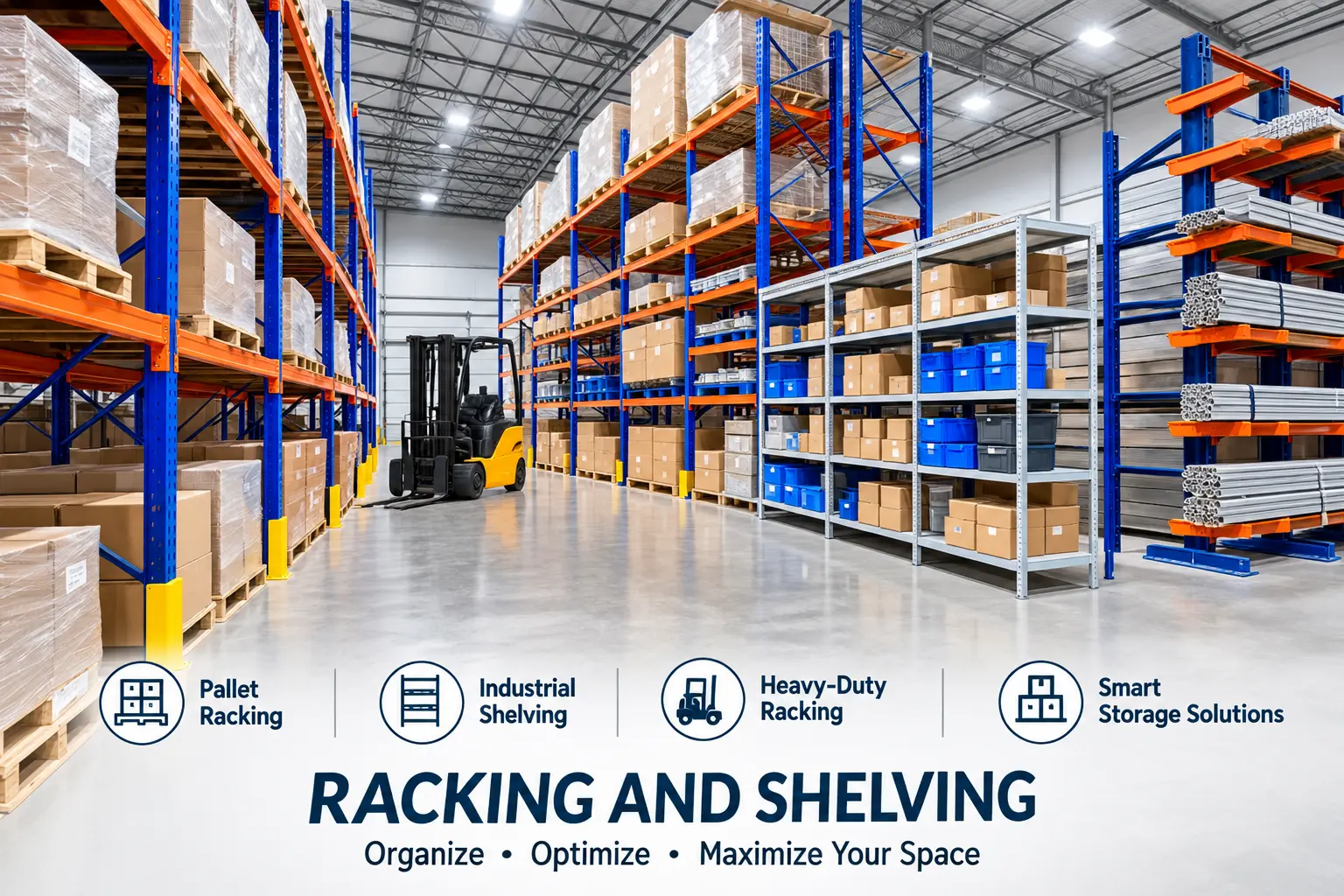
Different types of racking and shelving systems are designed to accommodate specific storage needs. Pallet racking is suitable for palletized goods, while heavy-duty industrial racking supports demanding warehouse storage applications. Drive-in racking increases storage density by using deep storage lanes, whereas mobile racking helps reduce the number of fixed aisles. Cantilever racking is ideal for long materials such as pipes and timber. Medium-duty shelving, long-span shelving, and bolt-free shelving provide flexible storage for cartons, tools, components, and smaller inventory.
How Do Warehouse Racking Systems Improve Storage Efficiency?
Warehouse racking systems help businesses use vertical space instead of relying entirely on floor-level storage. By arranging products in designated locations, warehouses can improve stock visibility, simplify picking operations, and reduce unnecessary movement. A well-planned layout can also support efficient inventory rotation, easier replenishment, and smoother forklift movement. For facilities handling large volumes of goods, the right warehouse racking configuration can increase storage capacity while maintaining practical access to inventory.
What Are the Benefits of Industrial Racking and Shelving?
For warehouses, manufacturing facilities, and distribution hubs, industrial racking and shelving provide a number of advantages. These technologies facilitate effective material handling, optimize available storage space, and enhance inventory organization. Product handling times can be shortened, stock accessibility can be enhanced, and various product weights and sizes may be accommodated with well-designed storage solutions. Businesses may be able to modify their storage arrangements in response to shifting operating needs thanks to modular layouts. These technologies help make warehouse operations safer and more efficient when they are properly chosen, installed, loaded, and maintained.
How Do You Choose the Right Racking Solutions?
Product size, load capacity, warehouse layout, inventory turnover, and material handling equipment must all be considered when selecting the best racking solutions. Before choosing a system, businesses should take into account the available floor area, ceiling height, aisle widths, and accessibility considerations. Evaluating safety regulations, anchoring, rack protection, and future growth requirements is also crucial. A good storage arrangement should strike a balance between product accessibility, safe warehouse mobility, and storage density.
What Is the Difference Between Racking and Shelving?
The primary distinction between shelving and racking is how they are supposed to be used for storage. Palletized items, bulk inventories, and larger loads which are frequently handled by forklifts or other material handling equipment are the typical uses for racking. Smaller goods, cartons, tools, and parts that need to be picked by hand are typically placed on shelves. But each system's design and rated capacity determine the difference. Warehouses can effectively arrange various inventory categories by combining the two choices.
Can Racking and Shelving Be Used Together?
It is possible to build a better structured warehouse storage environment by combining racking and shelves. While shelving can be utilized for smaller products, spare parts, and often selected items, pallet racking can hold palletized inventories and big goods. This combination helps companies better utilize limited warehouse space, handle various product categories, and enhance accessibility. Inventory needs, handling techniques, and safety concerns should all be taken into account while designing the arrangement.
How Can Racking Solutions Maximize Warehouse Space?
By efficiently utilizing vertical height and allocating inventory to specific storage areas, racking solutions optimize warehouse space. While suitable shelving arrangements enhance the management of smaller things, high-density systems can store more pallets in a given space. Workflow can be enhanced and wasted space can be decreased by choosing the appropriate layout. However, aisle access, weight restrictions, fire safety regulations, and safe material handling procedures must all be balanced with storage density.
How Can Warehouse Racking Safety Be Improved?
Choosing systems made for the necessary loads and making sure they are installed and anchored correctly are the first steps in guaranteeing warehouse racking safety. Vulnerable rack locations should have appropriate shielding where necessary, and load-capacity information should be prominently displayed. Frequent inspections can assist in locating faulty connectors, uprights, beams, and other parts. Damaged equipment should be evaluated, fixed, or replaced by qualified experts, and warehouse staff should obtain the necessary training. A safer storage environment can be maintained by adhering to relevant safety regulations.
Conclusion
Systems for racking and shelving are crucial for enhancing operating effectiveness, storage capacity, and warehouse management. Businesses can establish a safer and more productive storage environment by comprehending the many warehouse racking alternatives, choosing appropriate industrial racking, and putting successful racking solutions into practice. A well-thought-out storage system offers flexibility for future operational expansion while meeting present inventory needs.