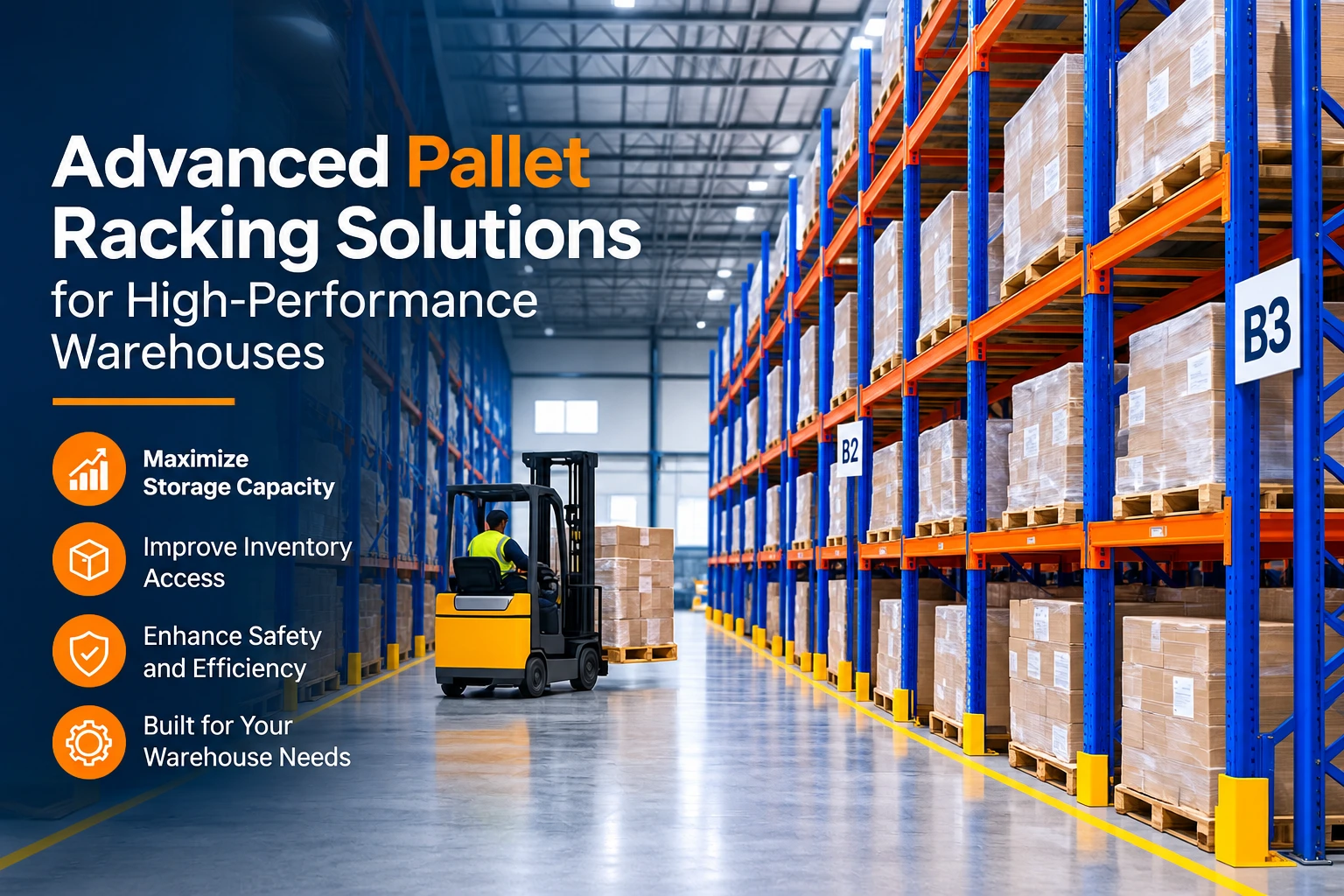
Modern warehouses require more than just greater room for storage. They need carefully thought-out storage solutions that facilitate quick inventory movement, effective material handling, secure operations, and evolving company needs. Pallet racking systems facilitate the vertical organization of palletized items, enhance inventory accessibility, and optimize warehouse area utilization.
Choosing the appropriate pallet racking solution can assist Saudi Arabian manufacturers, distributors, merchants, and logistics firms establish a more efficient and orderly storage environment. Selecting a system that fits the facility's inventory profile, operational workflow, and long-term capacity requirements is crucial.
Why Advanced Pallet Racking Solutions Matter
The efficiency with which storage space is integrated into daily operations determines warehouse performance. Unnecessary forklift movements, restricted pallet accessibility, and complicated inventory management are all consequences of poorly designed layouts.
Cutting-edge pallet racking solutions use thoughtfully planned storage arrangements to solve these problems. Building size, pallet loads, aisle requirements, and inventory turnover are all factors that firms can take into account when designing a storage layout that will support their operations going forward.
The right system can help warehouses:
- Increase pallet storage capacity within the available building footprint.
- Organize inventory into clearly defined storage locations.
- Improve the efficiency of loading, unloading, and picking activities.
- Support suitable inventory rotation methods.
- Reduce unnecessary movement through better warehouse layout planning.
- Adapt storage arrangements to changing product volumes and business needs.
Actual performance improvements depend on the warehouse design, equipment, and operating procedures.
Types of Pallet Racking Systems for High-Performance Warehouses
Different storage systems offer different advantages. Understanding their applications helps businesses select a suitable solution for their operational requirements.
1. Selective Pallet Racking for Direct Inventory Access
One of the most adaptable solutions for warehouses that deal with a variety of goods is selective pallet racking. Picking and restocking are simple because each pallet position is easily accessible from the aisle.
Businesses handling numerous stock-keeping units (SKUs), fluctuating inventory levels, and frequent order picking might benefit from its flexible layout.
Best suited for: Distribution centers, retail warehouses, spare-parts facilities, and general industrial storage.
2. Drive-In Racking for High-Density Storage
With drive-in racking, forklifts can access the rack structure through deep storage lanes. This arrangement can improve the number of pallet placements within a constrained footprint since fewer aisles would be needed.
When warehouses do not always need direct access to every pallet and store large quantities of comparable products, the technique works especially well.
Best suited for: Bulk inventory, production materials, and large quantities of similar goods.
3. Double-Deep Pallet Racking for Greater Storage Density
Forklifts can enter the rack structure thanks to deep storage lanes used in drive-in racking. This arrangement can improve the number of pallet positions within a constrained footprint because fewer aisles may be needed.
When warehouses hold large amounts of comparable goods and don't need constant direct access to every pallet, the approach works very well.
Best suited for: Warehouses seeking a balance between pallet capacity and product accessibility.
4. Push-Back Racking for Efficient Pallet Handling
Pallets can slide backward as more pallets are loaded into a storage lane thanks to push-back racking, which makes use of inclined rails and trolleys. Typically, pallets are loaded and unloaded from the same aisle.
By eliminating the requirement for distinct access aisles between individual rack rows, this configuration can increase storage density. In general, it works well with inventory that is maintained according to last-in, first-out (LIFO) principles.
Best suited for: Distribution facilities and warehouses storing multiple pallets of the same product.
5. Pallet Flow Racking for High-Throughput Operations
Pallet flow racking moves pallets from the loading side to the picking side using wheels or gravity rollers. In hectic warehouse settings, separating loading and retrieval can facilitate continuous material movement.
Pallet flow systems are beneficial for inventory with specified shelf-life or dispatch priority because they can facilitate first-in, first-out (FIFO) stock rotation when properly constructed.
Best suited for: High-volume distribution, food and beverage storage, and suitable date-sensitive products.
6. Mobile Pallet Racking for Space-Constrained Facilities
Installing mobile pallet racking on movable bases allows access aisles to be opened when needed. The arrangement allows access where and when it is required rather than keeping an aisle between each row of racks available all the time.
Although the design must take into consideration floor conditions, operational processes, access requirements, and appropriate safety controls, this structure can boost storage density..
Best suited for: Warehouses with limited floor space and a need for high storage capacity.
How to Design a More Efficient Pallet Storage Layout
Selecting a rack type is only one part of warehouse planning. A high-performance layout must also support the movement of goods from receiving through storage, picking, packing, and dispatch.
Analyze Inventory Characteristics
Determine the number of SKUs, pallet quantities per product, inventory turnover, and pallet retrieval frequency first. While massive amounts of comparable products might be appropriate for denser storage structures, fast-moving goods might need easy access.
Calculate Pallet Positions and Load Requirements
Calculate how many pallet positions are needed at each level of storage. Determine the maximum loaded weight and measure the pallet's dimensions.
For the suggested configuration, rack beams, upright frames, connectors, and other parts must be chosen. Instead than depending on broad estimates, a trained designer should confirm the relevant load capacities and design specifications.
Optimize Aisle Width and Equipment Movement
Forklift parameters, turning radius, load dimensions, lifting height, and the chosen racking configuration all affect aisle needs. Safe handling and operational access also require the proper clearances.
It is possible to prevent wasted space and needless movement by coordinating the racking layout with the material-handling equipment.
Plan for Future Expansion
Storage requirements can change as businesses introduce new products, increase order volumes, or expand distribution activities.
Planning for future capacity may involve reserving space for additional rack rows, allowing for changes in inventory profiles, or choosing a modular arrangement that can be adapted within the approved design limits.
Benefits of Pallet Racking Systems for Saudi Arabian Businesses
Saudi Arabia's industrial, logistics, retail, and manufacturing sectors depend on effective warehouse infrastructure. Businesses in Riyadh, Jeddah, Dammam, and other commercial centers can assess pallet racking systems as part of their wider storage and distribution strategy.
Better Use of Available Warehouse Space
Vertical storage helps businesses use available building height rather than relying exclusively on floor-level storage. The achievable capacity depends on ceiling height, building conditions, handling equipment, aisle widths, and safety requirements.
More Organized Inventory Management
Clearly assigned pallet positions can make it easier for warehouse teams to locate products, track inventory, and manage replenishment activities.
Improved Material-Handling Efficiency
A well-planned storage layout can help reduce unnecessary travel and support smoother movement between receiving, storage, picking, and dispatch areas.
Greater Flexibility for Different Products
Different racking configurations can accommodate a variety of pallet sizes, product categories, and storage requirements when properly designed.
Support for Business Growth
A storage system selected around realistic demand forecasts can help businesses prepare for increased inventory volumes without making premature changes to the warehouse building.
Warehouse Racking Safety and Maintenance
Storage efficiency should never come at the expense of safety. Pallet racking must be designed, installed, loaded, and maintained according to its approved specifications and applicable requirements.
Important safety measures include:
- Displaying accurate load-capacity information for the installed configuration.
- Using pallets that are suitable for the rack design and stored loads.
- Protecting vulnerable uprights against forklift impacts where appropriate.
- Keeping aisles, emergency exits, and pedestrian routes clear.
- Training employees in safe loading and unloading practices.
- Inspecting racks regularly and reporting damage immediately.
- Arranging competent assessment of damaged components before returning affected areas to service.
Changes to beam positions, rack configurations, or loading arrangements should not be made without checking that the revised setup remains within the approved design limits.
How to Choose the Right Pallet Racking Supplier
Choosing a suitable supplier involves more than comparing product prices. Businesses should evaluate whether the proposed solution addresses the facility's actual operating requirements.
Before making a decision, consider:
- Storage requirements: Does the proposal provide the required pallet positions and product accessibility?
- Engineering specifications: Are load capacities and rack configurations appropriately assessed?
- Warehouse compatibility: Does the layout accommodate the building, handling equipment, and operational clearances?
- Installation planning: Is installation based on an approved layout and suitable procedures?
- Long-term support: Are inspection guidance, maintenance requirements, and future planning considered?
A well-prepared proposal should explain how the system fits the warehouse rather than simply listing the rack components supplied.
Frequently Asked Questions
What are pallet racking systems used for?
Pallet racking systems store palletized goods in structured, often multi-level arrangements. They help warehouses organize inventory, use vertical space, and support material-handling operations.
Which pallet racking system offers the highest storage density?
Drive-in, push-back, pallet flow, and mobile racking can offer higher storage density than conventional selective layouts in suitable applications. The best choice depends on pallet accessibility, stock rotation, equipment, and operational requirements.
Are pallet racking systems suitable for heavy-duty warehouse storage?
Yes. Systems can be designed for heavy pallet loads when the components and configuration are appropriately specified and verified for the intended application.
Can pallet racking systems be customized?
Rack layouts and specifications can be selected according to pallet dimensions, load requirements, warehouse height, aisle arrangements, and handling equipment. Any customized design should be appropriately engineered and approved.
How can businesses improve warehouse storage efficiency?
Businesses can analyze inventory turnover, calculate required pallet positions, coordinate racking with forklift operations, select a suitable storage configuration, and establish effective inventory management and inspection procedures.
What information is needed for a pallet racking quotation?
Useful information includes warehouse dimensions, pallet size and weight, required pallet capacity, product categories, forklift specifications, and preferred stock rotation method. A floor plan or warehouse drawing can further support the assessment.
Conclusion
Advanced pallet racking solutions can help businesses create more organized, space-efficient, and productive warehouse environments. From selective systems that provide direct pallet access to high-density configurations designed for bulk storage, each option offers distinct advantages.
The most effective approach is to select a system based on real inventory requirements, warehouse dimensions, material-handling equipment, and safety considerations. With appropriate planning, installation, and maintenance, pallet racking can support reliable warehouse operations and long-term business growth.
AME Racking offers warehouse storage and racking solutions for businesses evaluating their industrial storage requirements in Saudi Arabia.