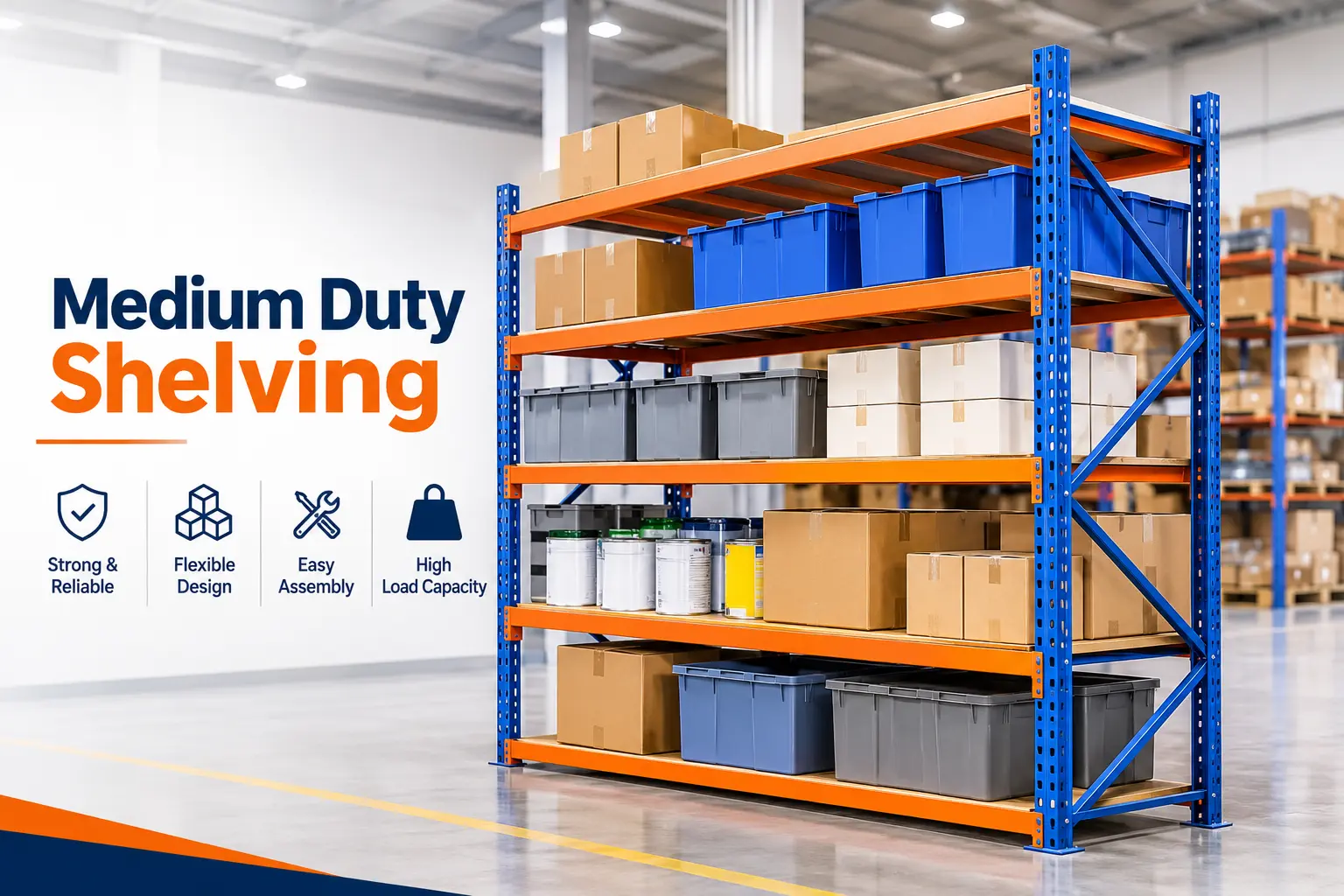
For warehouses, workshops, retail establishments, and industrial facilities that require dependable and well-organized storage for moderately heavy goods, medium-duty shelving is an efficient storage option. Medium-duty shelving helps organizations manage inventory while keeping a tidy and productive workplace by striking a balance between strength, accessibility, and space efficiency.
Medium-duty shelving provides more structural stability and load-bearing capacity than light-duty shelving, which is primarily used for smaller and lighter objects. Cartons, replacement parts, tools, equipment, packaged goods, and other inventory that needs to be easily accessible and arranged are all perfect for storing there.
What Is Medium Duty Shelving?
A steel storage system called "medium duty shelving" is made to accommodate rather heavy items on several shelves. Upright frames, horizontal beams, and movable shelves that may be arranged to suit various storage needs make up its structure.
Businesses can customize shelf heights according to the size of their merchandise thanks to the changeable design. Because of its adaptability, medium-duty shelving is appropriate for establishments with fluctuating inventory levels and storage requirements.
Key Benefits of Medium Duty Shelving
1. Efficient Space Utilisation
By utilizing vertical storage spaces, medium-duty shelving lets companies make the most of their limited floor space. More products can be kept in the same space with many shelf levels, which eliminates needless clutter.
2. Strong and Durable Construction
Medium-duty shelving is made from high-quality steel components and offers robust support for regular warehouse and industrial storage activities. It is appropriate for long-term use due to its sturdy structure.
3. Adjustable Shelf Configurations
The adjustable design of medium-duty shelving is one of its key benefits. Inventory management is made more versatile by the ability to adjust shelf levels to suit various product dimensions.
4. Easy Product Accessibility
Convenient access to stored goods is made possible by open shelving layouts. Workers don't need to follow complex handling procedures in order to swiftly identify, collect, and arrange products..
5. Improved Inventory Management
Businesses may retain stock visibility, ease inventory handling, and categorize products with the use of a well-organized shelving system.
Common Applications of Medium Duty Shelving
Medium duty shelving is suitable for various commercial and industrial environments, including:
- Cartons, packed items, and general inventories are arranged in warehouses.
- Workshops: Keeping maintenance equipment, tools, and parts.
- Retail Stores: Stocking backrooms and merchandise.
- Automotive Facilities: Handling servicing supplies, accessories, and replacement components.
- Manufacturing Units: Organizing supplies and parts for production.
- Distribution centers: facilitating effective inventory, sorting, and picking processes.
Medium Duty Shelving vs. Heavy Duty Racking
Different storage needs are met by heavy-duty pallet racking and medium-duty shelving.
Typically, medium-duty shelving is made for things that are reached by hand, cartons, and commodities that are somewhat heavy. Larger, heavier loads are meant for heavy-duty pallet racking, which is frequently used for forklift storage and retrieval.
Product weight, storage dimensions, handling techniques, available warehouse space, and operational needs all influence which of these systems is best.
How to Choose the Right Medium Duty Shelving System
Selecting the appropriate shelving system requires careful consideration of several factors.
- Load Capacity: Make sure the system is rated appropriately by calculating the weight of the materials kept on each shelf.
- Shelf Dimensions: Based on product sizes, select appropriate shelf heights, depths, and widths.
- Warehouse Layout: Take vertical clearance, aisle widths, and available floor space into account.
- Material Quality: Choose sturdy steel structures with appropriate protective coatings.
- Future Expansion: Select a configuration that is adaptable to evolving storage needs.
- Safety Requirements: Adhere to the load ratings, installation guidelines, and relevant safety regulations provided by the manufacturer.
Always confirm the rated capacity of each shelf and the complete shelving structure before installation.
Why Medium Duty Shelving Is Important for Modern Warehouses
Storage systems that facilitate effective operations without squandering important space are necessary for modern warehouses. For companies that deal with a variety of goods and want easy access to their inventory, medium duty shelving offers a useful solution.
Medium duty shelving increases warehouse productivity by streamlining material handling, optimizing vertical storage, and increasing product organization. It is flexible.
configuration also makes it easier for businesses to modify their storage arrangements as operational requirements change.
Conclusion
A useful and adaptable option for warehouses, workshops, retail establishments, and industrial settings is medium duty shelving. It assists companies in creating accessible and well-organized storage areas with its sturdy steel construction, movable shelf levels, and effective storage design.
Purchasing the proper shelving arrangement helps enhance inventory control, maximize available space, and facilitate more efficient day-to-day warehouse operations.