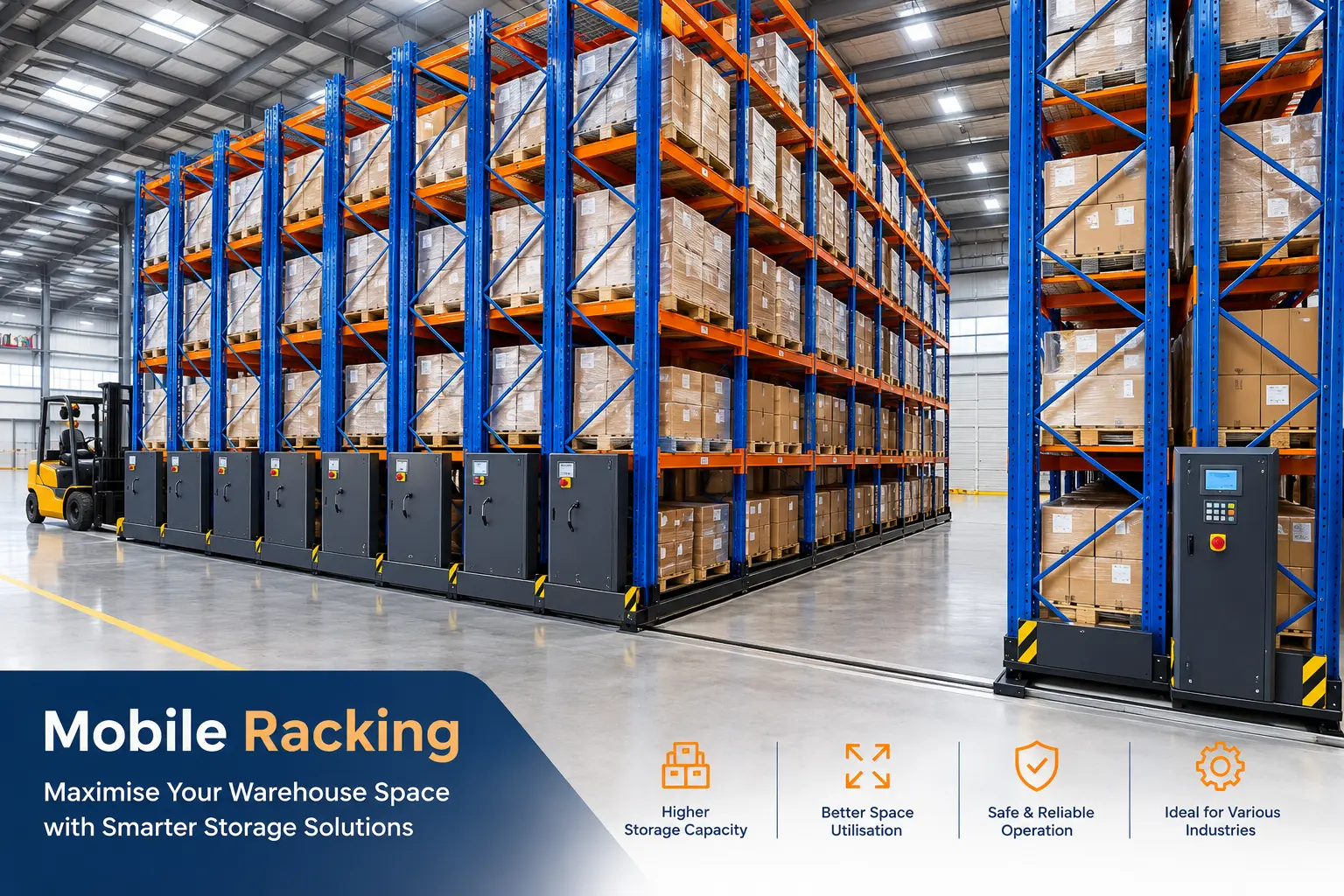
Introduction to Mobile Racking
Mobile racking is a cutting-edge warehouse storage system that maximizes floor space while preserving organized access to stored items. Mobile racking use moveable rack bases to create access aisles as needed, in contrast to traditional racking systems with permanent aisles. Businesses can boost storage capacity with this design without having to enlarge their current warehouse facilities.
Mobile racking has emerged as a viable option for distribution centers, manufacturing facilities, cold storage warehouses, and logistics operations as industrial storage demands continue to rise. Businesses can increase warehouse utilization and improve inventory management by combining limited product accessibility with space efficiency.
What Is Mobile Racking?
Rack structures are mounted on movable bases that move along floor-mounted rails or guided tracks in mobile racking, a high-density storage solution. When access is not required, the rack rows can move closer together, and when operators need to retrieve or store products, they can move apart to form an aisle.
More storage spaces can be found within the same building footprint thanks to this arrangement, which decreases the floor surface devoted to permanent aisles. Palletized items, industrial components, cartons, and other appropriate inventory can all be configured for mobile racking, depending on the purpose.
How Does a Mobile Racking System Work?
Storage frames, movable bases, tracks, drive mechanisms, and safety controls work together to power a mobile racking system. In motorized systems, the rack rows move to allow access to the selected storage region once operators choose the necessary aisle via a control interface.
The aisle can be closed and the rack rows put back in their compact position once the necessary products have been stored or retrieved. Safe mobility is supported by emergency stops, safety sensors, and suitable operating controls. The equipment design and handling practices in the warehouse determine the precise working procedure.
Key Benefits of Mobile Racking Systems
Maximum Warehouse Space Utilisation
Reducing the number of aisles that are always open is one of the key benefits of mobile racking. Businesses can utilize more of their available floor area for storage by grouping rack rows together when access is not needed. In warehouses where growth is challenging or new property expenses are considerable, this is especially beneficial.
Increased Storage Capacity
Pallet positions can be expanded with mobile racking without the need for a larger structure. Rack dimensions, aisle requirements, building layout, and the handling equipment utilized all affect the actual capacity boost. Businesses can better utilize their current warehouse infrastructure while accommodating expanding inventory with a well-thought-out arrangement.
Improved Cold Storage Efficiency
Facilities that use freezers and cold storage frequently incur high costs related to building operations and refrigeration. In temperature-controlled settings, mobile racking can improve useful storage capacity while minimising the amount of floor area devoted to permanent aisles. Equipment must be properly specified for the facility's safety regulations, operating temperatures, and condensation.
Better Inventory Organisation
By offering specific storage spaces for various goods, pallets, and materials, mobile racking facilitates organised inventory placement. It can assist companies in maintaining precise stock placements, planning replenishment activities, and enhancing control over stored goods when paired with efficient warehouse management practices.
Reduced Need for Warehouse Expansion
Businesses may think about extending their facilities or renting more space when storage capacity runs out. Because it can boost storage density within the current footprint, mobile racking offers an alternative worth considering. Installation expenses, inventory needs, upkeep, and how aisle access affects day-to-day operations all influence the financial gain.
Different Types of Mobile Racking Systems
Powered Mobile Pallet Racking
Powered mobile pallet racking uses electric drive mechanisms to move heavy-duty rack rows along guided rails. Operators select the required aisle through a control panel or approved operating interface. This system is suitable for warehouses requiring high pallet density, including industrial facilities and cold storage operations.
Manual Mobile Racking
Manual mobile racking uses a mechanical mechanism to move storage units without powered drives. It may be suitable for smaller installations or lighter-duty storage applications, depending on the manufacturer's specifications and the loads involved. Businesses should confirm that the system can safely support the intended storage requirements.
Mobile Shelving Systems
Mobile shelving applies the same space-saving principle to smaller items, tools, spare parts, cartons, and documents. Shelving units move along tracks to create access aisles when needed. These systems are commonly considered for parts rooms, maintenance departments, archives, and facilities where organised storage is essential.
Mobile Racking vs. Conventional Pallet Racking
Mobile racking and conventional pallet racking serve different operational priorities. Conventional pallet racking has fixed rows and permanent aisles, allowing operators to access multiple storage aisles simultaneously. This arrangement can be beneficial for warehouses with high picking activity and frequent forklift movements.
Mobile racking reduces the number of permanent aisles by moving storage rows to open access only where required. This makes it attractive for businesses that prioritise storage density over simultaneous access to every aisle. The best choice depends on inventory turnover, handling requirements, available floor space, and the number of aisles that must remain accessible during busy periods.
Where Is Mobile Racking Used?
Cold Storage Warehouses
Mobile racking helps cold storage facilities maximise pallet capacity within refrigerated and freezer environments. Its space-efficient design can be valuable where additional storage capacity is needed without expanding the temperature-controlled building.
Manufacturing Facilities
Manufacturers can use mobile racking to organise raw materials, production components, spare parts, and finished goods. A well-planned layout helps maintain designated storage locations and supports more efficient material handling.
Distribution Centres
Distribution centres handling a broad inventory can use mobile racking when high storage density is a priority and aisle access can be coordinated with operational workflows. The system should be evaluated against order-picking frequency and required throughput.
Industrial Storage Facilities
Industrial warehouses can use mobile racking to store compatible palletised goods, equipment, and materials in a compact configuration. Proper load assessment and layout planning are essential to ensure that the installation meets the facility's operational and safety requirements.
Important Factors to Consider Before Installation
Load Capacity and Rack Design
Every mobile racking installation must be designed around the weight, dimensions, and distribution of stored loads. Rack frames, beams, movable bases, and supporting components must meet the specified loading requirements. Accurate load information helps ensure that the system is suitable for the intended application.
Floor Conditions and Rail Installation
The warehouse floor must be assessed for structural capacity, flatness, level tolerances, and the loads imposed by the movable bases and rails. Any necessary floor preparation should be identified before installation to support reliable movement and long-term performance.
Aisle Width and Handling Equipment
Aisle dimensions must accommodate the forklifts or other handling equipment used in the facility. The layout should provide appropriate clearances for safe loading, unloading, and movement while balancing storage density with operational accessibility.
Inventory Turnover and Accessibility
Warehouses with frequently accessed products may need more simultaneous aisle access than facilities storing slower-moving inventory. Evaluating picking frequency and replenishment requirements helps determine whether mobile racking is appropriate for the operation.
Safety Features and Staff Training
Mobile racking systems should incorporate suitable safety controls based on their design, including emergency stops and protective sensors where required. Operators must understand the approved procedures for moving rack rows, accessing aisles, and responding to faults.
Mobile Racking Maintenance and Safety
Regular inspections and preventive maintenance help keep mobile racking systems reliable and safe. Rack frames, beams, connections, rails, wheels, drive mechanisms, and control systems should be checked according to manufacturer recommendations and applicable safety requirements.
Warehouse operators should keep operating areas clear, follow specified load limits, and report impacts or unusual movement promptly. Any suspected structural damage or safety fault should be assessed by qualified personnel before the affected equipment returns to service. Maintaining inspection and maintenance records also supports consistent warehouse safety management.
Is Mobile Racking a Cost-Effective Investment?
Mobile racking can offer long-term value when the cost of increasing storage density is lower than the alternatives available to a business. Although its initial investment may be higher than conventional static racking, the additional storage positions can help reduce pressure to lease or construct extra warehouse space.
Businesses should compare the installation cost with the expected storage capacity, building constraints, maintenance requirements, energy consumption for powered systems, and the impact on picking productivity. A professional layout proposal should identify the expected pallet positions and aisle-access arrangements so that the decision is based on actual operational needs rather than general capacity estimates.
Conclusion
Mobile racking provides an effective approach to high-density warehouse storage by reducing the need for permanent aisles and making better use of available floor space. It can support industrial warehouses, manufacturing facilities, distribution centres, and temperature-controlled storage operations where capacity is a priority.
Selecting the right system requires careful consideration of load requirements, inventory turnover, floor conditions, handling equipment, and safety procedures. With appropriate design, installation, and maintenance, mobile racking can help businesses improve storage utilisation and prepare their warehouses for future inventory growth.