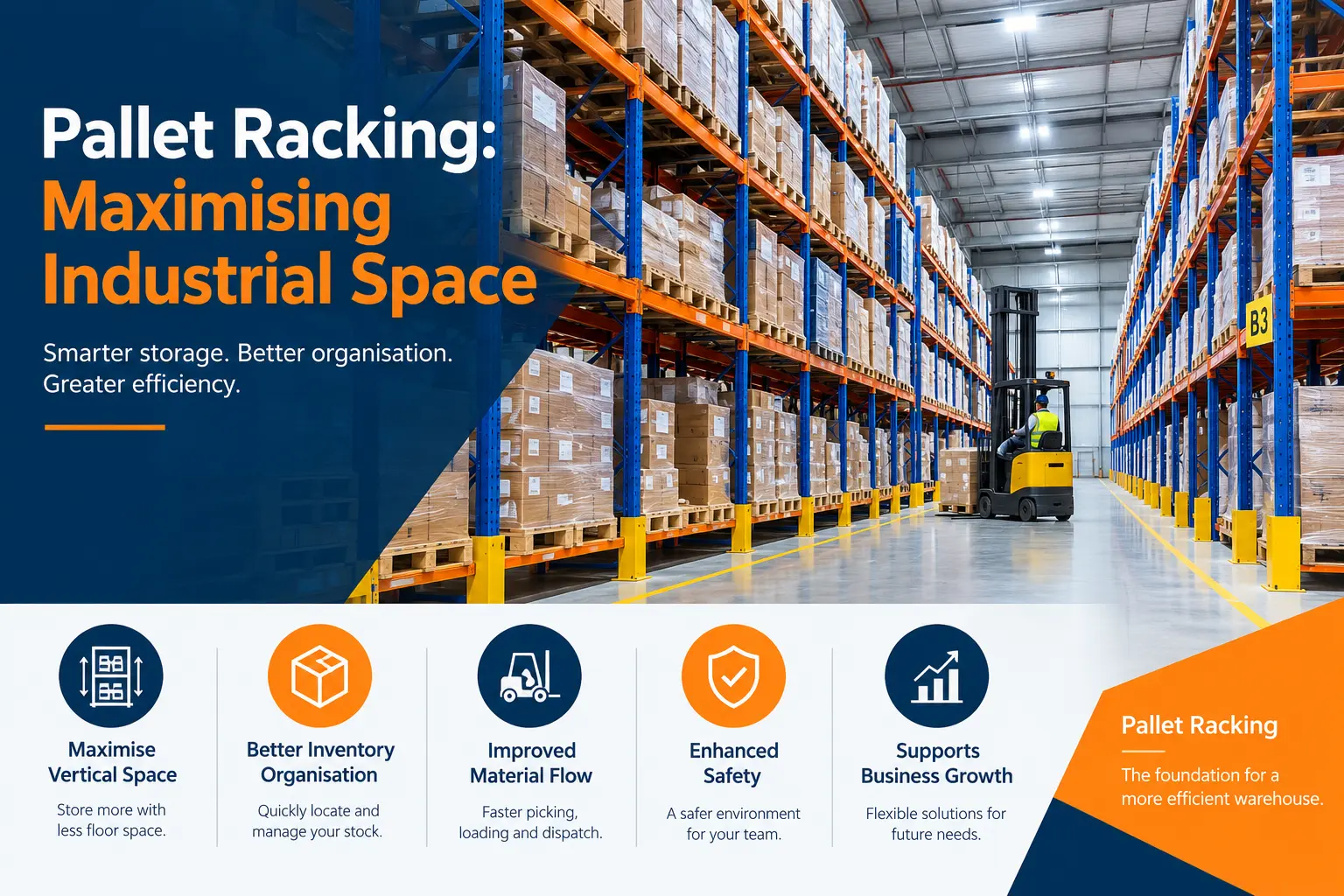
The effectiveness of industrial storage is determined by how well a warehouse makes use of its available footprint, building height, and material-handling routes. Inadequately designed storage can limit future growth, lengthen the time it takes to retrieve products, and impede forklift movement. Without sacrificing accessibility or safety, pallet racking is a strategic warehouse storage solution that helps companies maximize space, arrange inventory, and enhance material flow.
Strategic Space Utilisation with Pallet Racking
In order to sustain effective receiving, picking, and dispatch processes, modern warehouses must handle growing inventory levels. Pallet racking reduces reliance on floor-level storage by allowing enterprises to store palletized goods across several vertical levels.
greatest productivity isn't usually achieved with greatest storage density, though. Pallet locations, aisle requirements, stock movement, and equipment capacities are all taken into account in a well-designed architecture. Finding the ideal balance between operational accessibility and storage capacity is the goal.
Effective warehouse optimisation starts with matching the storage design to the way inventory moves through the facility.
Choosing the Right Pallet Racking System
Each Pallet Racking configuration offers different operational advantages. Selecting the appropriate system requires an assessment of inventory characteristics, order profiles, stock rotation, and available warehouse dimensions.
Selective Pallet Racking for Direct Access
Selective pallet racking provides individual access to each stored pallet. It is particularly effective for warehouses managing diverse product lines, variable stock levels, and frequent picking activities. Its flexibility makes it a practical option for distribution centres and general industrial storage.
Drive-In Racking for High-Density Storage
Drive-in racking stores pallets in deep lanes that forklifts enter during loading and retrieval. It can increase pallet capacity for products stored in larger quantities, although reduced direct access must be considered when planning inventory rotation.
Double-Deep Racking for Increased Capacity
Double-deep racking places two pallets deep in each storage position, reducing the number of aisles required compared with a suitable selective layout. The design must account for compatible handling equipment, pallet accessibility, and retrieval procedures.
Push-Back Racking for Dynamic Storage
Push-back racking uses wheeled carts on inclined rails to store multiple pallets deep. It can improve storage density while allowing pallets to be loaded and retrieved from the same aisle, making it useful for selected last-in, first-out inventory applications.
Pallet Flow Racking for Stock Rotation
Pallet flow racking uses gravity-assisted rollers to move pallets through dedicated lanes. When configured appropriately, it supports first-in, first-out inventory rotation and can improve throughput in operations with predictable product flows.
Engineering Considerations for Pallet Racking
Reliable Pallet Racking performance begins with accurate technical planning. Rack dimensions, component specifications, load characteristics, and installation conditions must be evaluated together.
Load capacity and configuration: Beam capacities, upright frames, connection details, and bay arrangements must be appropriate for the intended loads and approved system design.
Pallet dimensions and condition: Variations in pallet size, load overhang, and pallet quality can affect compatibility, stability, and safe placement.
Clear height and building constraints: Roof structures, sprinklers, lighting, columns, and other building services can influence the usable storage height and layout.
Forklift and aisle requirements: Equipment turning radii, lifting heights, and handling methods must be considered when setting aisle widths and rack clearances.
Floor and anchoring conditions: The supporting floor and anchoring arrangement must be suitable for the installed system and its design loads.
These considerations help prevent capacity assumptions, layout conflicts, and costly modifications after installation.
Improving Warehouse Productivity Through Better Layout Planning
When storage locations are chosen based on operational requirements rather than just capacity, pallet racking can increase productivity.
Products that move quickly can be assigned to places that minimize travel during the choosing process. While properly marked rack locations assist staff in regularly locating merchandise, receiving and dispatch spaces should be set up to prevent needless congestion.
Stock visibility and location accuracy can be further enhanced by integrating storage positions with a warehouse management system. To find areas for layout enhancements, businesses can also examine picking frequency, forklift travel, and space use.
The result is a more structured storage environment in which space planning supports daily warehouse performance.
Pallet Racking Safety and Operational Control
Disciplined operational processes are necessary for high-density storage. System integrity might be jeopardized by improper loading, forklift accidents, broken parts, and unapproved rack modifications.
Warehouse managers should make sure staff members are aware of authorized loading and handling methods, maintain clear load notices, and conduct regular visual checks and risk-based inspections. It is important to check for damage to uprights, beams, bracing, anchors, and protective gear.
When a rack is suspected of having structural damage, a qualified individual should evaluate the system and control the afflicted region. Instead of using haphazard techniques, repairs and replacements must adhere to authorized technical specifications.
A safe Pallet Racking installation depends on correct design, controlled loading, competent inspection, and consistent operator training.
Pallet Racking for Industrial Growth in Saudi Arabia
Saudi Arabian manufacturing companies, distribution hubs, and industrial facilities need storage solutions that can adapt to fluctuating inventory levels and operational requirements.
Businesses may optimize warehouse height, enhance product organization, and boost material handling efficiency with a well-designed pallet racking system. The facility's actual dimensions, inventory profile, equipment, and any applicable local requirements should all be reflected in the final layout.
Future demand planning is similarly crucial. Businesses can select a storage solution that is appropriate as operations change by assessing possible changes in pallet sizes, product lines, and throughput.
Conclusion
Industrial space optimisation requires a coordinated approach to storage design, inventory management, equipment movement, and safety. Pallet Racking provides the structural framework for organising palletised goods, but its effectiveness depends on selecting the correct configuration and planning the installation around actual operational requirements.
By combining sound engineering, efficient layout planning, and consistent maintenance, businesses can maximise the practical value of their warehouse space and build a storage operation prepared for long-term growth.