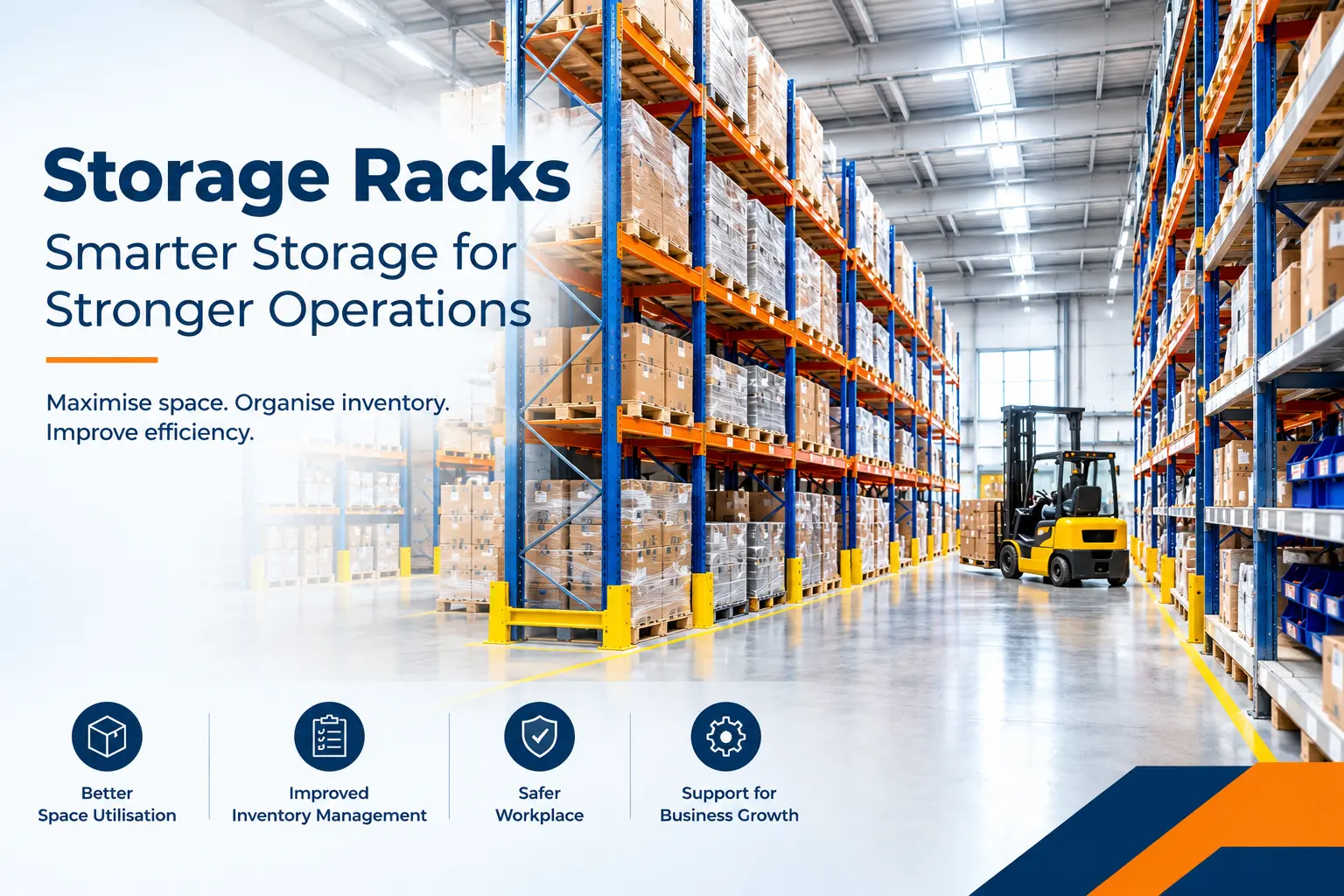
Every warehouse has a storage challenge: accommodating products of different sizes, maintaining clear access to inventory, and moving materials without creating unnecessary delays. As stock volumes increase, floor stacking and poorly organised storage areas can make these tasks more difficult. Industrial storage racks provide a structured framework for managing inventory while making better use of the available warehouse space.
However, an effective storage solution should do more than hold products. It should support the movement of materials, suit the characteristics of the inventory, and remain practical as operational requirements change.
Understanding the Role of Storage Racks in Modern Warehouses
Storage racks create designated positions for goods, helping businesses separate product categories and establish consistent storage arrangements. Depending on their design, they can accommodate pallets, cartons, components, long materials, and bulky industrial products.
In a busy facility, clearly organised storage locations can help employees identify products, retrieve the correct items, and return replenished stock to the appropriate positions.
The system should be selected according to the warehouse's actual requirements rather than assuming that one rack configuration will suit every application.
Selecting Storage Racks According to Product Characteristics
The physical properties of stored goods have a significant influence on rack selection.
Palletised Products
Businesses storing goods on pallets may consider selective pallet racking when direct access to individual pallet locations is important. This arrangement can support a wide range of product lines and simplify access for picking and replenishment.
The design must account for pallet dimensions, load weight, beam capacity, handling equipment, and the required aisle arrangement.
Small Components and Packaged Goods
Spare parts, cartons, tools, and smaller products often require shelving rather than large pallet positions. Industrial shelving can create accessible storage levels and help separate items by category, size, or picking frequency.
For operations with many small stock-keeping units, consistent labelling and location management are particularly useful.
Long Industrial Materials
Pipes, metal sections, timber, and other elongated products can be difficult to store on conventional shelves. Cantilever racking provides projecting support arms that can be configured for suitable long loads.
The design should consider material length, weight distribution, support spacing, and the method used to load and retrieve products.
High-Volume Inventory
Where large quantities of similar goods are stored, higher-density systems may improve the use of available space. Drive-in racking is one option, provided its access pattern and stock rotation characteristics match the operation.
Higher density is not automatically better. Businesses must also consider retrieval requirements, handling time, and access to individual products.
How Storage Racks Influence Material Flow
Warehouse efficiency depends on how easily goods move between receiving, storage, picking, packing, and dispatch.
A well-planned storage layout places products according to their operational requirements. Frequently picked inventory may need convenient access, while reserve stock can be positioned in areas suited to replenishment activities.
Storage locations should also be coordinated with equipment routes and pedestrian movement. Poorly positioned racks can create bottlenecks, unnecessary travel, and conflicts between handling equipment and workers.
The goal is to organise storage around the movement of materials, not simply to fill every available space.
Practical Methods for Improving Storage Efficiency
Warehouse managers can improve storage performance through several targeted measures.
Analyse inventory movement. Review which products move frequently, which remain in storage for extended periods, and which require special handling. This information helps determine suitable locations and storage configurations.
Standardise storage locations. Use a consistent location numbering and labelling system to make products easier to find and return.
Review underused space. Identify areas affected by unsuitable shelving, inconsistent pallet dimensions, or poorly planned storage positions before investing in additional equipment.
Separate operational zones. Establish practical arrangements for receiving, inspection, reserve storage, picking, and dispatch to reduce unnecessary movement.
Plan for changing inventory. Review whether new products, packaging formats, or demand patterns will affect the suitability of the existing rack arrangement.
These measures work best when supported by accurate inventory records and clear warehouse procedures.
Storage Rack Capacity: Why Correct Specification Matters
A storage rack's suitability cannot be determined from its appearance or dimensions alone. Its permitted capacity depends on the approved design, component specifications, configuration, and loading conditions.
Before a system is used, businesses should confirm that the equipment is appropriate for the intended application. Beam levels, upright frames, connectors, bracing, and support arrangements must match the specified design.
Loads should be positioned and distributed according to the system's requirements. Changes to beam positions, rack layouts, or stored products may require technical review.
Never assume that a rack can safely carry a particular load without verifying its applicable capacity information.
Protecting Storage Racks in Busy Industrial Environments
Forklift impacts, incorrectly positioned pallets, and unauthorised alterations can compromise rack safety. Preventive measures should therefore be incorporated into warehouse procedures.
Depending on the layout and risk assessment, useful measures may include rack-end protection, clearly marked traffic routes, suitable aisle widths, operator training, visible load notices, and regular inspections.
Any damaged component should be reported promptly and assessed by a competent person. Repairs and modifications should follow the appropriate technical requirements rather than relying on improvised solutions.
Good housekeeping is equally important. Clear aisles and properly organised storage positions help maintain access and reduce avoidable operational hazards.
Planning Storage Racks for Future Requirements
Businesses often change their inventory mix as product lines expand, customers' requirements evolve, or production volumes increase. A storage layout that works today may become restrictive if future needs are not considered.
Planning should account for potential changes in pallet sizes, stock quantities, handling equipment, and picking methods. It should also recognise building limitations and the need to preserve safe access.
A flexible approach does not mean installing adjustable equipment without limits. Any reconfiguration must remain within the approved design and capacity requirements.
Finding the Right Industrial Storage Solution
Selecting storage racks requires a balanced assessment of space, inventory, accessibility, load requirements, and warehouse workflow. Selective pallet racking, industrial shelving, cantilever systems, and higher-density configurations each serve different purposes.
The right choice is the one that meets the facility's operational needs while maintaining appropriate safety and accessibility.
For information about warehouse racking and industrial storage solutions, visit AME Racking Company at https://ameracking.sa/.
Conclusion
Storage racks are a fundamental part of warehouse organisation, but their value depends on how well they are matched to inventory and material flow. Careful planning can help businesses improve accessibility, organise products, and use available space more effectively.
By combining suitable rack configurations with accurate load management, consistent warehouse procedures, and ongoing inspections, businesses can create a more dependable industrial storage environment.